Données de traduction
Raineke-Raposo
Année de publication: 2000
Données sur les originaux traduits
-
GOETHE, Johann Wolfgang. REINEKE FUCHS. [S.l.]: [s.n.], 1794.
Langue(s): AlemãoLittérature nationale: Alemã
- FE-EA-Escola de Aplicação-USP
Données Wikipédia
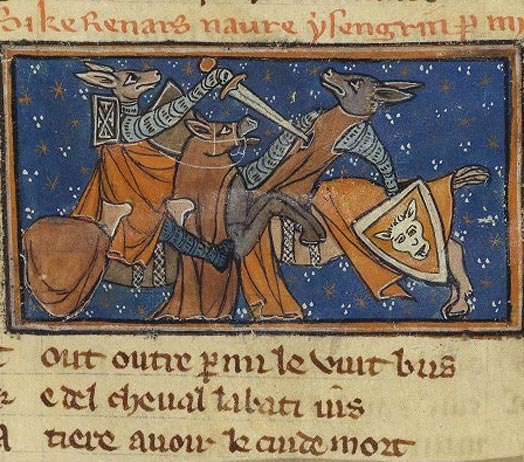
Reynard the Fox is a literary cycle of medieval allegorical Dutch, English, French and German fables. The first extant versions of the cycle date from the second half of the 12th century. The genre was popular throughout the Late Middle Ages, as well as in chapbook form throughout the Early Modern period. The stories are largely concerned with the main character Reynard, an anthropomorphic red fox and trickster figure. His adventures usually involve his deceiving other anthropomorphic animals for his own advantage, or trying to avoid their retaliatory efforts. His main enemy and victim across the cycle is his uncle, the wolf, Isengrim (or Ysengrim). While the character of Reynard appears in later works, the core stories were written during the Middle Ages by multiple authors and are often seen as parodies of medieval literature, such as courtly love stories and chansons de geste, as well as a satire of political and religious institutions. The trickster fox, Reynard, lives in a society of other talking animals (lion, bear, wolf, donkey, etc.), making the stories a beast epic. The original copies were written in Old French, and have since been translated into many different languages. However, the tales of Reynard come from all across Europe and each retelling has details that are specific to its area. The tales, no matter where they take place, are designed to represent the society around them and include the structures of society around them, such as a noble court. While the authors take many liberties with the story telling, not all of the satire is meant to be rude or malicious in intent.
Voir sur WikipédiaDescription
Catálogo da Fonte: N. Reg. 028.5 G599r 2000